From snowplowing and water systems to public records and financial reporting, local government is more complicated than it looks. Our new infographic explores the challenge—and some constructive ways forward.
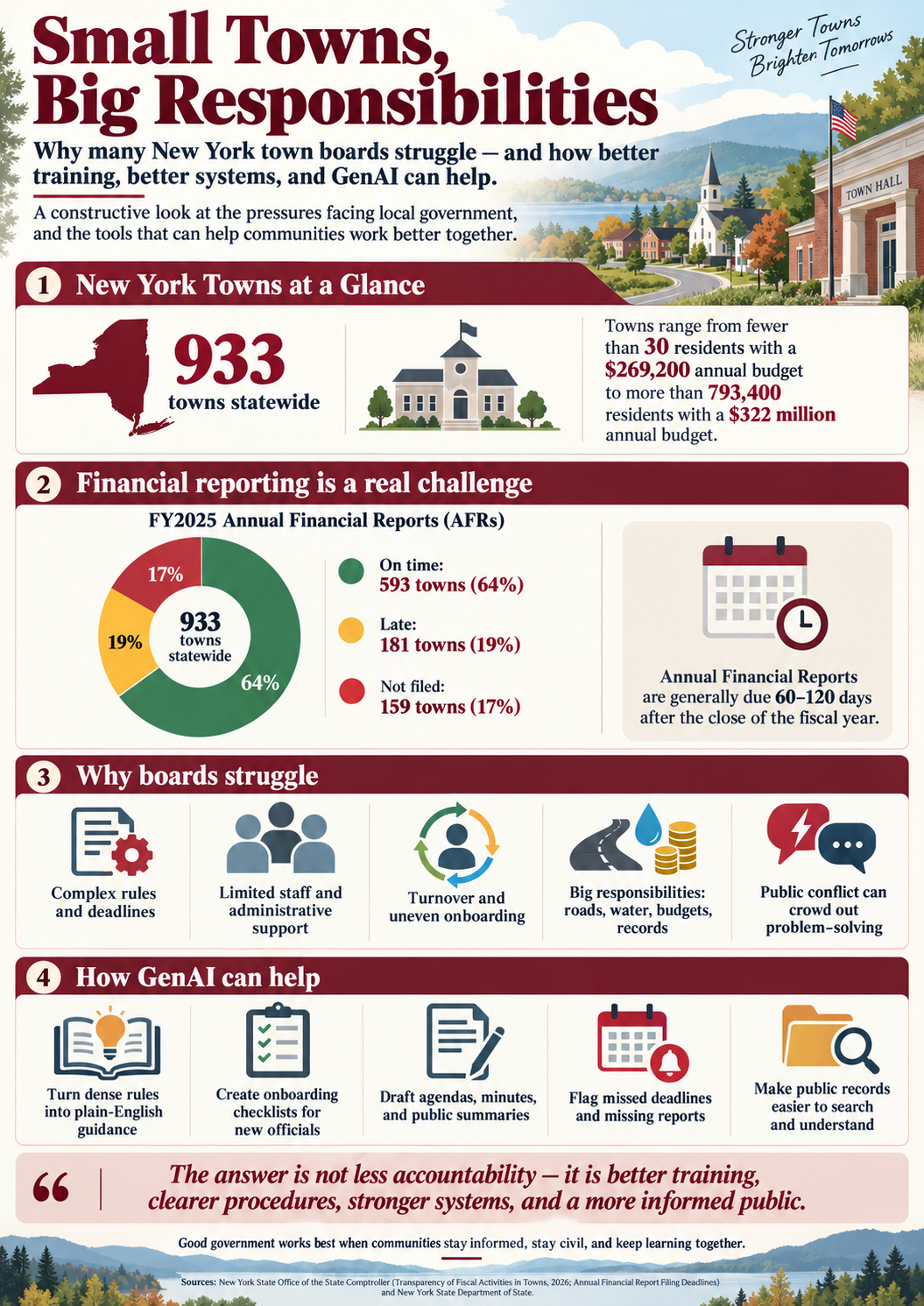
At a Glance
- 933 towns serve New York communities of dramatically different sizes and resources.
- 36% of towns filed their fiscal year 2025 Annual Financial Reports late or had not filed them when the State Comptroller assessed compliance—not 36% with late budgets.
- Better systems help. Clear records, training, realistic staffing, and routine oversight can make public service easier and government more transparent.
- AI could assist. Source-linked answers, draft checklists, and record searches are possibilities, provided humans verify the results.
What the numbers really mean
New York has 933 towns. According to the New York State Comptroller’s September 18, 2026 statewide audit, they range from communities with fewer than 30 residents and a budget of about $269,200 to towns with more than 793,400 residents and budgets of approximately $322 million. Yet each must manage essential public responsibilities.
The same report documents a significant challenge in financial reporting for fiscal year 2025:
- 593 towns (64%) filed their Annual Financial Reports on time.
- 181 towns (19%) filed after their statutory deadlines.
- 159 towns (17%) had not filed as of the Comptroller’s review.
Together, the late and not-filed groups account for approximately 36% of the state’s towns. These are Annual Financial Reports, which summarize what a town received, spent, and held—not the town’s annual budget or a finding that all those towns are in financial distress. Reporting deadlines vary by population, generally 60 to 120 days after fiscal year-end, and extensions may be available for some towns.
The Comptroller also reviewed a selected group of 18 towns and found problems with accounting records and board oversight. Those results describe the selected towns, not necessarily all 933. Read the audit and methodology.
Why is small-town government so demanding?
Even a relatively small town must deal with roads, water, public safety, budgets, employees, procurement, open meetings, and records. Some officials serve part-time, and staffing and expertise vary enormously. Elected officials are not all unpaid volunteers, but many balance their duties with other commitments.
The difficulty is not an excuse for missed legal duties. It is a reason to make good performance easier: reliable accounting, clear checklists, timely document access, training for new officials, and consistent oversight.
Where could generative AI fit?
Imagine a newly elected official asking a secure, source-linked tool: “Where is the resolution approving this expenditure?” Or a resident asking: “Where can I find the minutes and votes from last month’s meeting?”
If a town first organizes its authoritative public records, carefully governed AI tools could make those documents easier to search, explain complex rules in plain language, and prepare draft checklists or summaries for staff to verify. They could also flag a potentially missing entry for human review.
But AI must not become the official recordkeeper, auditor, lawyer, or decision-maker. It can get facts wrong, invent answers, and mishandle sensitive information. Any pilot should rely on approved records, link to original documents, limit access appropriately, and require human verification before official use.
A better conversation for Hartwick
As residents consider the future of town government, there are useful questions to ask of every official and every candidate: How will public records be made easier to find? What training and professional support do officials need? How will financial reports and meeting minutes be checked for completeness? How can residents help without turning every disagreement into a personal confrontation?
These questions don’t presume that any one candidate or officeholder is responsible for statewide problems. They focus on processes that matter no matter who serves.
The answer is not less accountability. It is better training, clearer procedures, stronger systems, and a more informed public.
For a longer discussion, see our earlier essay: Small-Town Government Is Hard. What If We Helped Each Other Do It Better?
Sources and context
- New York State Comptroller — Transparency of Fiscal Activities in Towns (September 18, 2026)
- New York State Comptroller — Annual Financial Report Filing Deadlines
- New York State Comptroller — Academy for New York State’s Local Officials
- New York Department of State — Local Government Handbook
Editorial note: The statewide figures above describe fiscal year 2025 annual financial reporting; they do not establish Hartwick’s filing status or the causes of any particular town’s delay. The infographic presents potential AI uses for discussion, not a claim that Hartwick has implemented them. This is a nonpartisan public-information article.

